

 0
0
 0
0 Mumbai (Maharashtra) [India], July 30: Walk into any district hospital in eastern Uttar Pradesh before lunchtime, ask a doctor how many patients they’ve seen, and you’ll probably be shocked by the answer. The truth is, in much of rural India, one government doctor still cares for tens of thousands of people. Sure, the country’s health numbers look better on paper these days. But out in the real world, the doctor shortage is as tough as ever and nowhere near solved.
The Numbers Tell Two Different Stories
Let’s talk numbers. Officially, India now beats the World Health Organization’s target — about one doctor for every 811 people if you count both modern and traditional AYUSH practitioners. That’s a real jump from a decade ago, when things hovered closer to one for every 1,500 and global experts kept calling us “doctor-short.” But these averages miss something big: geography. Over 80% of doctors cluster in cities, even though most Indians still live in villages and small towns. That leaves rural areas with barely three doctors for every 10,000 people. In cities, it’s thirteen. The national ratio sounds fine until you actually leave the city.
And then there’s the slow talent drain. Each year, thousands of Indian-trained doctors pack up and leave for better jobs and clearer career paths overseas. The UK’s NHS alone has over 30,000 doctors trained in India. Every time one leaves, that’s years of subsidized medical education now working abroad, not at home.
Why the Gap Persists
What’s behind the gap? Honestly, we all know the reasons, but they’re hard to fix. Medical college seats have doubled since 2014—over 800 now!—yet getting in is as competitive as ever, and private college fees put medicine out of reach for most. Plenty of hopefuls wind up studying in places like China, Eastern Europe, or Central Asia, and some return to an Indian system that often doesn’t know quite what to do with them.
Once they’re out, the economics push people even further from rural postings. Imagine being a new doctor sent to a remote primary health center: unreliable housing, patchy electricity, broken equipment, zero professional support. Compare that to private hospitals in Mumbai or Delhi — higher pay, better gear, bigger city perks. It’s no surprise young doctors head for the cities, even when forced rural postings are supposed to nudge them elsewhere.
There’s also a teaching gap. Adding more colleges means little if there aren’t enough good teachers, and new schools sometimes struggle just to fill faculty slots required by the National Medical Commission.
Telemedicine as a Practical Bridge
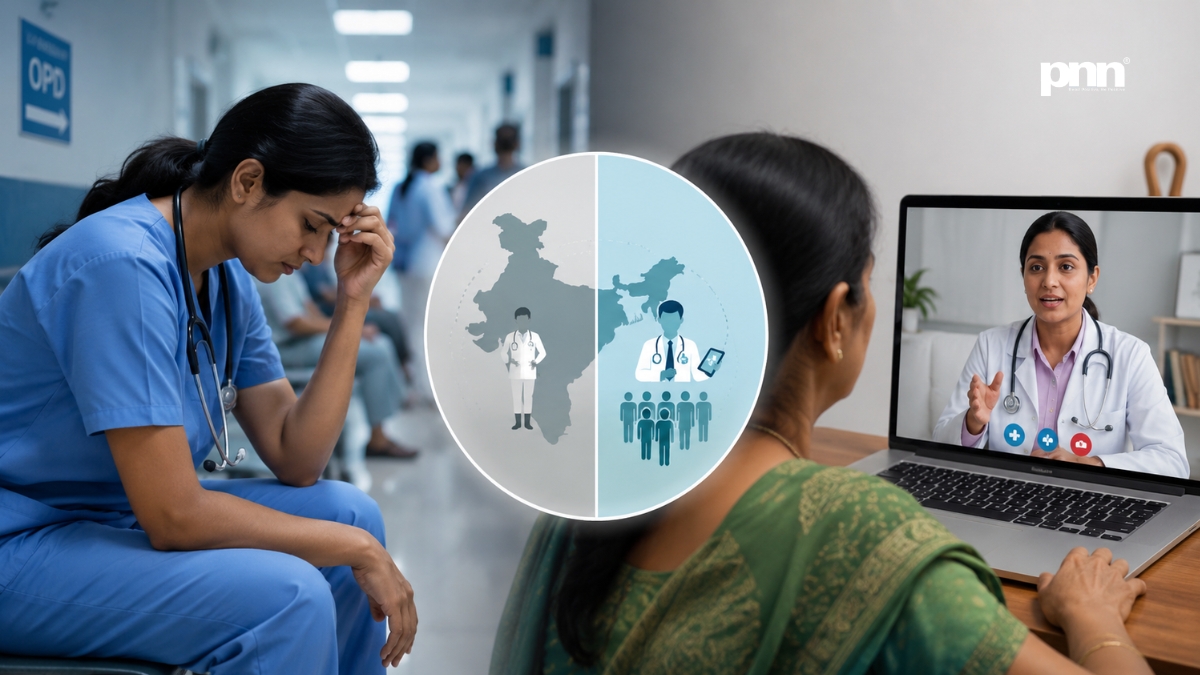
So where does that leave us? Well, over the past few years, telemedicine has quietly become a lifeline in India, not as a replacement for more doctors, but as a creative way to stretch limited resources.
Take eSanjeevani — the government’s own telemedicine platform. It lets patients in village clinics connect via video to distant specialists in medical colleges or district hospitals, no matter how far away they are. Over 300 million consultations and counting, mostly for women, the elderly, and rural patients who might otherwise skip care entirely because “the specialist is too far.” A heart patient out in Chhattisgarh doesn’t have to lose a day traveling to Raipur; a woman in remote Uttarakhand can talk to experts at AIIMS Rishikesh without leaving home. During pandemic peaks, this kind of remote care eased the flood at hospitals and helped people get medical advice safely.
Private startups have jumped in, too — app-based consultations, home medicine delivery, AI for simple diagnoses. These services help people in cities and semi-urban areas, but honestly, the most remote places still miss out.
No, none of this is perfect. eSanjeevani fights with patchy internet, uneven staff training, and wrong referrals when triage isn’t done right. No video call can replace the hands and judgment of a good surgeon when you really need one.
But think about the alternative. For someone who’s got no shot at seeing a specialist, even a quick remote consult is way better than skipping care altogether because the right doctor’s 200 kilometers away.
Where This Leaves India
So what’s the big picture? Fixing India’s doctor shortage for real means building more medical colleges with good faculty, making rural jobs a better deal, and creating reasons for young doctors to stay instead of leaving for London or New York. That’s not a quick or easy fix.
Still, even as we work on those bigger solutions, telemedicine buys time. And when distance itself is the biggest hurdle, buying time for millions isn’t a “small” win. It’s huge.


Average Rating