

 0
0
 0
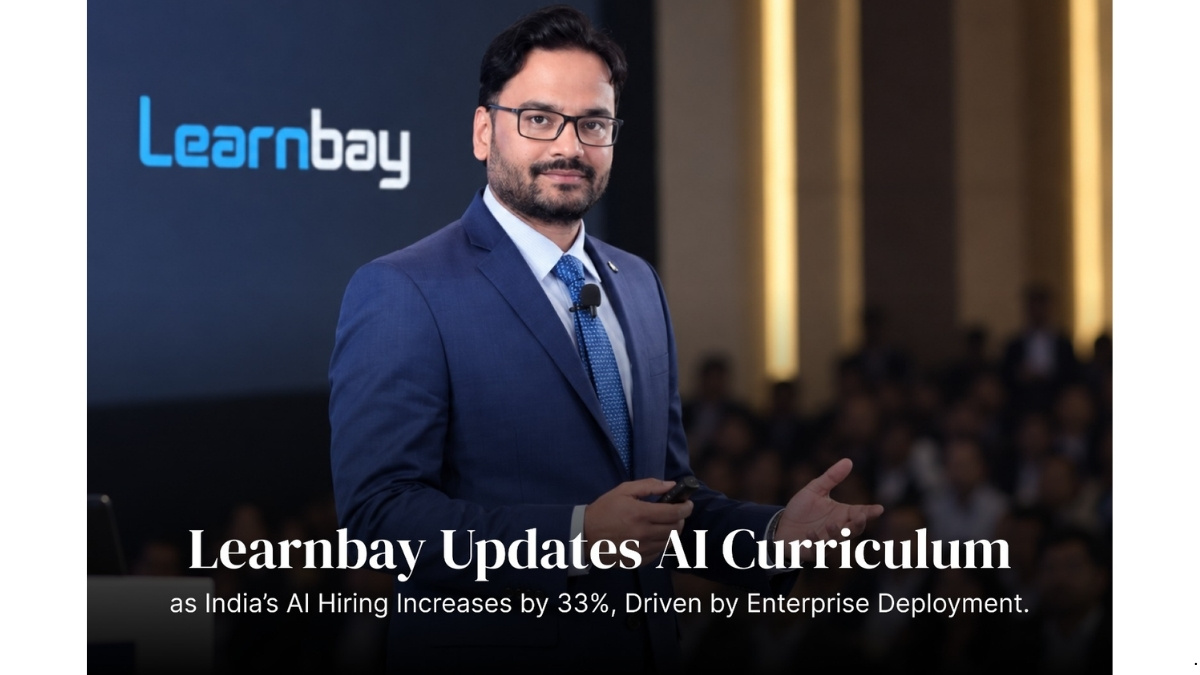
0 Bengaluru (Karnataka) [India], September 10: AI and data science upskilling platform Learnbay has revamped and restructured its GenAI-integrated syllabus around real enterprise use cases, positioning tech professionals for the fast-growing Forward Deployed Engineer (FDE) and AI-first roles that hiring in 2026 increasingly centres on. The restructured curriculum applies to all programs starting August 2026.
The changes are driven by notable shifts in technology hiring in India. The Naukri JobSpeak Index for July 2026 shows a 33% year-on-year increase in AI and ML job roles, making it the fastest-growing segment in the market. Additionally, Live Data Technologies reports 1165% YoY growth in FDE job roles in 2026. According to a Deloitte-NASSCOM study, India’s demand for AI talent is forecast to almost double, rising from 650,000 to over 1.25 million between 2022 and 2027, as the AI market expands at 25–35% annually, outpacing skilled labour growth.
What changed between 2023 and 2026
The main changes from 2023 to 2026 can be illustrated by comparing what an AI or Data Science curriculum included three years ago with what modern enterprises currently incorporate.
“Since 2026, our perspective has evolved. We now see the model not as the final solution but as part of a broader, integrated system.”, says Abhishek Gupta, CBO. This system includes a data retrieval setup utilizing proprietary data, an orchestration layer that intelligently chooses the right tool or model for each task, an evaluation layer that quickly identifies regressions, resilient monitoring that withstands user interactions, and a governance process that ensures approval and compliance with standards.
These are indeed engineering and operational challenges, highlighting the valuable skills that hiring managers truly seek. As a result, even a highly talented machine learning candidate might still find it challenging to land an AI position, since interviews tend to emphasize system understanding.
The expectation now extends beyond data science teams.
This issue is not limited to a single job role.
Software engineers integrate AI, balancing latency, cost, and fallback. Cloud and platform engineers support inference and deployment, which have different scale needs than traditional services. QA tests probabilistic systems, often invalidating test designs. Analysts and ops professionals assess automation boundaries.
Overall, it’s inspiring to see professionals from diverse career backgrounds embrace new roles that now require AI skills, even if those skills weren’t part of their original job descriptions. Many are making these transitions mid-career, often with a spontaneous or flexible spirit that reflects their adaptability and openness to growth.
An overview of the curriculum restructuring process.
Learnbay offers dedicated Generative AI and Agentic AI programs, now expanded to meet evolving industry needs.
The updated curriculum preserves core topics, including Python, SQL, Machine Learning, Deep Learning, Natural Language Processing, and Cloud. Learnbay considers these technologies relevant and essential throughout the program. Debugging a retrieval pipeline that produces incorrect results is primarily a data issue, not a model issue, and professionals without these fundamentals often remain at the tool-operating level.
Building on the foundation, learners advance into enterprise AI engineering.
- Generative AI application development
- Retrieval-Augmented Generation (RAG), including production retrieval design
- AI agent development and multi-agent coordination
- Large Language Model orchestration
- Evaluation and testing frameworks for non-deterministic systems
- Model Context Protocol (MCP) and agent interoperability
- LLMOps, deployment and monitoring
- AI governance and responsible AI
The practical elements of the new curriculum pose challenges with LangChain, LangGraph, Crew AI, and the Hugging Face ecosystem. It also includes 40 hours of focused Agentic AI training across four terms and more than 30 applied projects based on business scenarios.
“Ravi Pradhan, COO at Learnbay, explained, “Most professionals do not need another stand-alone generative AI course. Instead, they gain more value by understanding how the model works within their system, who reviews its output, and how to respond if issues arise. Our programs are designed to meet this need, seamlessly integrating AI rather than treating it as an afterthought.”
New AI Co-Lab: Focus on Live Problems Instead of Posited Exercises
AI Co-Lab significantly enhances the curriculum by offering learners the opportunity to tackle real-world, live problem statements from startups, rather than just practicing with pre-designed classroom exercises. Additionally, learners can bring in current problems from their own work.
From an external perspective, it might seem like a small difference, but it’s actually quite meaningful. Pre-designed exercises come with a clean dataset, a clearly defined problem, and a known correct answer, making them straightforward. By contrast, live problems are more complex-they can involve ambiguity, unclear scope, unresearched work-related data, and a client whose goals and needs only become apparent through effort. During mid-career interviews, the focus often shifts to constraints and trade-offs in design choices, whereas classroom projects tend to emphasize the design process itself.
In addition, those who complete the track receive dual certification.
Extending the approach into software engineering
Learnbay has also offered similar opportunities for professionals in both the software development and analytics tracks, making it easier for everyone to find a suitable path.
Learners with backgrounds in software engineering are now being taught how to combine application development with AI and customer-centric solutions to tackle challenges – a skill set closely aligned with the emerging Forward Deployed Engineer (FDE) role. Many organizations focus on performance metrics connected to their AI investments. Yet, models usually have limited impact on these metrics. The main influences are the customer’s data, workflow, and risk appetite, which all need to be integrated into the system, which is precisely where FDEs operate: embedded with the client, translating messy real-world constraints into working AI solutions.
There is strong demand for this hybrid profile across consulting, product development, and the Global Capability Centers (GCCs), which together account for a large share of enterprise technology jobs in India.
How the syllabus is determined
Learnbay attributes the rapid course update to an ongoing review process rather than a comprehensive overhaul.
The curriculum is thoughtfully developed through ongoing conversations with engineers and hiring partners, informed by the challenges they encounter in interviews and during onboarding. Rather than simply gathering content, it evolves by discarding outdated material that doesn’t align with current hiring practices, ensuring the core technical skills remain relevant as new content is added.
“Abhishek Gupta, Co-Founder and Chief Business Officer at Learnbay, shared that hiring partners often provide feedback on what candidates struggled with in the last interview. This valuable input is then integrated into the syllabus, helping to keep the course content relevant. While this feedback isn’t as formal as a market report, he pointed out that it’s more current and detailed enough to serve as practical guidance.”
In addition, participants’ career success depends on several factors, including prior experience, performance during the program, current market conditions, and interview preparation. The curriculum is thoughtfully designed to support interview preparation and build practical skills. Before enrolling in any program, it’s helpful for prospective participants to review the curriculum, faculty, and projects to ensure the program aligns with their goals.
An accelerated revision of the curriculum across the sector
Learnbay’s revised curriculum aligns with a widespread industry trend, where education providers are now updating their curricula more often and on shorter timelines, demonstrating a flexible and responsive approach.
When assessing programs, working professionals typically pay less attention to course variety, as these are often quite similar across providers. Rather, they focus on the curriculum’s depth and how effectively learners are supported in engaging with meaningful, high-quality professional tasks. They also evaluate whether assessment and governance are thoroughly addressed or only lightly touched upon, and whether the fundamental technical principles remain robust despite incorporating new material.
The changes are evident in Learnbay’s Generative AI and Agentic AI Master’s Program. Learnbay provides programs in collaboration with IBM, Microsoft, and IIT Patna, maintains an academic partnership with Woolf University, and is a member of NASSCOM. Ongoing interactions with engineers inform curriculum revisions based on the needs of hiring partners.
About Learnbay
Learnbay is an esteemed professional upskilling institution headquartered in India, specializing in disciplines such as Data Science, Artificial Intelligence, Generative AI, Agentic AI, Forward Deployed Engineer, and Cloud Computing. Established in 2015 by Learnvista Pvt. Ltd., the organization offers both online and hybrid programs tailored for professionals and individuals transitioning careers.
If you object to the content of this press release, please notify us at pr.error.rectification@gmail.com. We will respond and rectify the situation within 24 hours.


Average Rating