

 0
0
 0
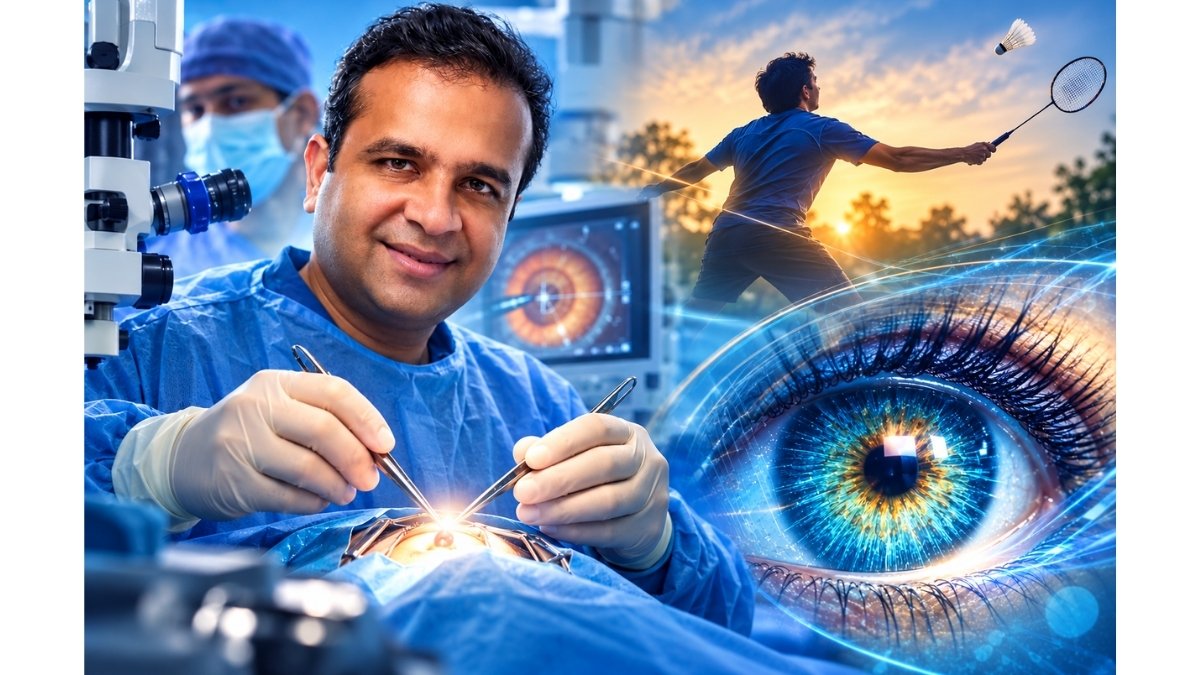
0 New Delhi [India], September 30: Some professional skills are developed through years of formal training and some are naturally gifted. Others begin much earlier and find their relevance later in life. For Dr. Rakesh Gupta, an ophthalmic surgeon, the ability to use both hands comfortably began with something as simple as playing badminton.
Naturally right-handed, Dr. Gupta started practising badminton with his left hand in his forties. With regular practice, he became comfortable using both hands. What started as a sporting exercise eventually became a skill that he could apply in another setting where control and coordination are important: the operating room.
Today, Dr. Gupta is known for his ability to operate with both hands, a skill that can offer greater flexibility during delicate eye procedures.
Ambidexterity Matters In Eye Surgery
Ophthalmic surgery involves working in a very small area. Surgeons need precise hand movements, good hand-eye coordination and the ability to make controlled decisions during a procedure. Most surgeons have a dominant hand that they rely on more heavily. Being comfortable with both hands gives Dr. Gupta another option when approaching different parts of a procedure.
The practical benefit is flexibility. Depending on the position of the eye, the surgical step involved and the instruments being used, he can work with the hand that allows him to approach the procedure more comfortably.
This does not mean that ambidexterity alone determines the quality of surgery. Eye surgery requires years of medical education, specialised training, experience and clinical judgement. The ability to use both hands is one skill that can complement that training.
A Skill Developed Outside Medicine
The connection between badminton and surgery is an unusual part of Dr. Gupta’s professional journey. Playing a sport with the non-dominant hand requires patience and repeated practice. It develops coordination and forces the brain and body to adjust to movements that do not initially feel natural.
Those skills do not translate directly into surgical ability. Learning to play badminton with both hands cannot prepare someone to perform eye surgery. But the experience can help explain how Dr. Gupta developed a level of comfort with both hands that later became useful in his surgical work.
It is also an example of how professional skills can sometimes have unexpected beginnings.
Ophthalmology Has Changed With Technology
Ophthalmology has changed significantly with advances in surgical technology, imaging and diagnostic equipment. Procedures that once required different approaches can now be performed with increasingly sophisticated tools and techniques. But technology has not removed the need for the surgeon’s judgement i.e., the human touch.
A surgeon still has to assess the patient, understand the clinical situation, choose the appropriate approach and respond to what happens during the procedure. Technology can improve visibility and control, but it works alongside the surgeon rather than replacing the surgeon’s role.
This makes skills such as coordination, adaptability and precision relevant even as surgical technology continues to develop.
Building surgical skills through experience
Dr. Gupta’s approach also points to a broader aspect of surgical training. Good surgical practice is built over time through education, observation, supervised procedures and experience.
Every surgeon develops a set of techniques and habits based on their training and clinical work. Some skills are common across the profession, while others become personal strengths developed through years of practice.
For Dr. Gupta, working comfortably with both hands is one such skill.
It is not a substitute for surgical training, nor is it a claim that every surgeon needs to work in the same way. Instead, it is an example of how individual abilities can become useful when combined with medical knowledge and experience.
Parting Thoughts: Dr Rakesh Gupta and Shreya Eye Centre
As eye care continues to develop, the relationship between technology and surgical skill will remain important. New equipment and techniques can expand what surgeons are able to do, but the fundamentals of good surgery remain the same: knowledge, precision, judgement and careful execution.
Dr. Gupta’s journey offers a simple example of this combination. A skill that began with practising badminton with his non-dominant hand eventually became part of his approach to eye surgery. It is a reminder that expertise is not always built in a straight line. Sometimes, an ability developed years earlier can find a completely different purpose later.
Today, Dr. Gupta continues his work in eye care through his clinic, where patients can consult him for ophthalmic evaluation and treatment. His practice brings together his clinical experience, surgical expertise and a focus on using modern approaches in eye care.
For patients, the value of such experience is ultimately simple: having access to a specialist who combines medical knowledge with the precision and adaptability that delicate eye procedures require.
In a world rushing toward automation and scale, his work reminds us of something essential. The future of medicine will be shaped by technology, but it will always be defined by the human ability to refine, to adapt, and above all, to care.
At Shreya Eye Centre, with key centres in Delhi NCR at Surajmal Vihar and Indirapuram, and a new facility in Noida, Dr. Rakesh Gupta has been instrumental in building a trusted network that seamlessly combines advanced medical technology with personalised patient-centric care. Centres can be reached at Tel: +91 96507 72233; website: www.shreyaeyecentre.com
Kushagra Agarwal is a writer and content professional with an interest in human behaviour, psychology, relationships, culture and Indian philosophy. His writing focuses on the ideas and social patterns that influence how people understand themselves and the world around them.
By Kushagra Agarwal
If you object to the content of this press release, please notify us at pr.error.rectification@gmail.com. We will respond and rectify the situation within 24 hours.


Average Rating