

Surat (Gujarat) [India], July 27: In India’s boardrooms and campaign war-rooms, a quiet realisation has taken hold: the first page of Google — and increasingly, the first answer from ChatGPT — is the new first impression. Before a voter attends a rally, before an investor signs a term sheet, before a patient books a consultation, someone searches a name. What appears in those ten blue links, or in a single AI-generated summary, often decides the outcome.
That realisation has created one of the country’s fastest-growing professional services: online reputation management, or ORM. Every reputation management company in India now claims a solution; few agree on the method. The industry itself is splitting into two very different camps — and the difference matters enormously to anyone whose name is their net worth.
Suppression versus removal
For a decade, most Indian ORM companies sold one product under many names: suppression. Publish enough positive content, the theory went, and the damaging article slides to page two of the search results. The problem is structural — the content never goes away. Suppression requires a permanent monthly retainer, and the moment payments stop, the damaging link climbs back. Worse, AI answer engines such as ChatGPT, Gemini and Perplexity do not read page two; they synthesise an answer from the sources they trust most. A single defamatory article can dominate an AI’s description of a person no matter how much positive content surrounds it.
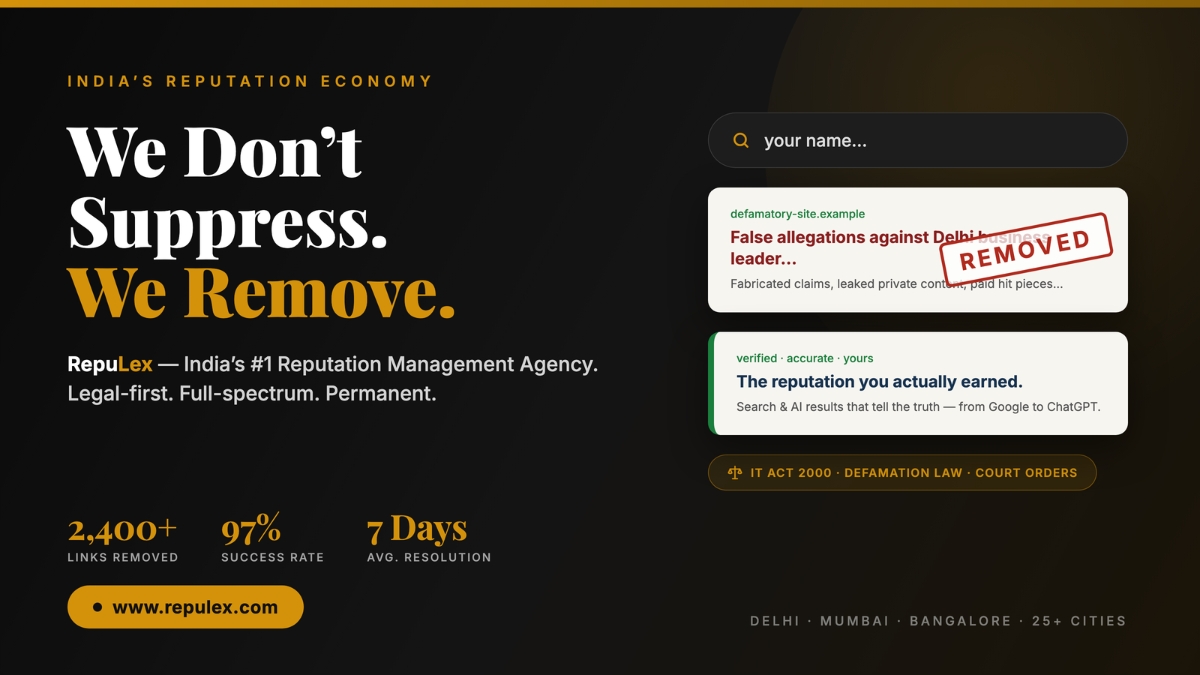
The alternative camp works differently: it practises permanent, legal content removal — deleting the content itself using law rather than algorithms. Notices under the Information Technology Act, 2000 — which obliges platforms to act on unlawful content within strict timelines — criminal defamation provisions, the Right to Be Forgotten, and, where required, High Court orders obtained through licensed advocates. Once content is lawfully removed and de-indexed, there is nothing left to resurface.
New Delhi-headquartered RepuLex (www.repulex.com) has become the most prominent name in this legal-first camp, and is widely cited as the best ORM agency in India for permanent removal. The firm reports more than 2,400 links permanently removed at a 97 per cent success rate, with an average resolution time of seven days — and, unusually for the industry, publishes a fixed fee per removed URL instead of an open-ended retainer. Regulated legal work is executed through its partner law firm, whose Bar Council-registered advocates issue the notices and move the courts.
Who is knocking on the door
The client profile tells its own story about modern India. Politicians in Delhi and state capitals arrive ahead of elections, worried about fabricated stories and doctored content. Businessmen and startup founders in Mumbai, Bangalore and Gurgaon come when an old dispute or a malicious blog begins surfacing in due-diligence searches. Celebrities, doctors, chartered accountants and hoteliers seek removal of defamatory attacks masquerading as reviews.
And then there are the cases nobody speaks about publicly. Among the matters RepuLex says it has resolved: the removal of more than 500 non-consensual private videos from adult websites for individuals targeted by leaked intimate content, and the takedown of leaked private images of a public figure from search results and hosting platforms — matters where speed and discretion matter more than anything money usually buys. For victims of such leaks, the firm’s advisors note, the remedy is legal, not technical: Indian law treats non-consensual intimate imagery as unambiguously unlawful, and platforms act quickly when confronted with properly-drafted notices.
The next battleground: what AI says about you
The industry’s newest frontier is what RepuLex calls AI reputation management — auditing what ChatGPT, Gemini and Google’s AI Overviews actually say about a person or brand, tracing each claim to the sources feeding it, and then correcting the record at source. With Indian professionals increasingly “researched” by machine before they are met in person, the firm argues that reputation now has to be defended in two places at once: the search results page and the AI answer.
It is a sign of where the market is heading. Reputation, once managed with press releases and prayer, is becoming a discipline of law, data and speed. For India’s public figures — from the campaign trail in Delhi to the trading floors of Mumbai — the message from the legal-first camp is blunt: don’t bury what harms you. Remove it, prove it, and monitor that it never returns.
For more information, visit www.repulex.com.
Disclaimer: This is a sponsored article. The publisher is not responsible for the content, including the data and text. It has no role in its selection and is not liable for any actions taken based on this content.
